

Remembering Moore’s Ford: Community Marks 80 Years Since Walton County’s Darkest Chapter |
Uncovering the Unseen: Reflecting on Deadly Lynching in Walton County, GA 80 Years Later. Discover the lasting impact. |
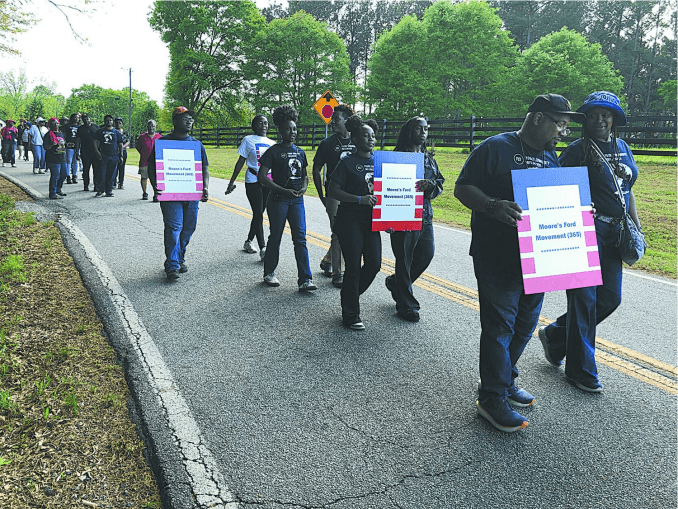
Dozens of community members gathered this past weekend to reflect on one of the most painful chapters in Walton County history—the 1946 Moore’s Ford lynching—marking 80 years since the tragic killings of two Black couples at the Oconee County line.
The day’s events combined remembrance, education, and a renewed push for justice. Attendees participated in a reenactment at the actual site near where the Moore’s Ford bridge once stood, along with a guided tour of key locations tied to the case. The observance also coincided with the anniversary of Dr. Martin Luther King Jr.’s death, adding deeper significance to the day’s reflection on civil rights and racial justice.
A Crime That Still Echoes Today
The Moore’s Ford lynching remains one of the most widely known unsolved mass lynchings in American history.
The events began on July 14, 1946, when Roger Malcom was arrested after a violent altercation with a white farmer. Eleven days later, after his bond was posted, Malcom, his pregnant wife Dorothy, and fellow sharecroppers George and Mae Murray Dorsey were driven from the Walton County jail.
Instead of returning home, the group was intercepted near Moore’s Ford by a mob of armed men. They were forcibly removed from the vehicle and shot to death in broad daylight.
Despite multiple investigations over the decades, no one was ever charged.
Searching for Justice Decades Later
Although official investigations by the FBI and Georgia Bureau of Investigation have been closed, the case continues to draw attention from activists and historians.
Former state representative Tyrone Brooks, founder of the Moore’s Ford Movement, emphasized that the pursuit of truth is not over. He pointed to sealed federal grand jury transcripts from the original investigation as a potential source of new information—records that advocates have long sought to access.
“We’re here for history, we’re here for justice, we’re here for remembrance,” Brooks told attendees gathered at First African Baptist Church in Monroe.
Rev. Ed Dubose of the NAACP echoed that message, calling for continued leadership and determination in seeking answers. “Nothing is going to deter us,” Dubose said.
Walking Through History
Participants traveled to several significant locations connected to the victims:
At some sites, the passage of time was evident. Overgrown areas and minimal upkeep served as a stark reminder of how easily history can fade without continued attention. Brooks himself paused to clear debris from one of the gravesites, underscoring the importance of preserving these places.
A Powerful Experience for AttendeesFor many, the day served as both an education and an emotional experience.
Some attendees described the reenactment and tour as a rare opportunity to connect with history in a meaningful way. Others reflected on how far society has come—and how far it still has to go.
One attendee noted that events like these offer perspective on progress, while also reinforcing the importance of civic engagement, including voting, as a way to continue moving forward.
Reenactment Brings History to Life
The day concluded with a powerful reenactment at the Moore’s Ford site. As actors portrayed the events leading up to the lynching, the sounds of raised voices, pleas for mercy, and simulated gunfire filled the air—creating a chilling but impactful reminder of what occurred there 80 years ago.
Earlier reenactments also depicted the initial altercation that led to the arrests and moments of Black citizens asserting their right to vote—highlighting the broader social climate of the time.
For participants like actor James Potts, the goal was clear: to give voice to those whose stories were nearly lost.
“These people need to be able to tell their stories,” he said. A History That Demands Remembrance
Eighty years later, the Moore’s Ford lynching remains both a historical landmark and an open wound. Events like this weekend’s gathering serve not only to remember the victims, but to continue the conversation around justice, accountability, and the importance of preserving local history.
As Walton County continues to grow and evolve, community leaders say it is critical that stories like Moore’s Ford are never forgotten—and that the search for truth, no matter how delayed, is never abandoned. |
0 Comments
Join the conversation
Be the first to comment
Share your thoughts above.